Changelog

New features, improvements, and fixes shipped to InsForge.

Web Scraper Integration

InsForge now connects to Apify in one OAuth click. Open Web Scraper in the dashboard, click Connect Apify, and authorize your own Apify account. Once connected, your coding agent can pull external data on demand without you wiring up any keys.

Connect from the dashboard or the CLI:

bash
insforge webscraper apify connect

The Web Scraper page also shows a copyable prompt: paste it into Claude Code, Cursor, or any coding agent running the InsForge skill and it drives Apify through the insforge webscraper apify skill, with no manual apify login or API keys.

Backend Advisor on Self-Hosted

The Backend Advisor now ships in the open-source, self-hosted dashboard. It has been available on InsForge Cloud, and the same scan now runs on self-hosted projects too: it checks your database and backend for security, performance, and health problems and points you at the fix.

Every finding comes with a copyable remediation prompt you can paste into any coding agent to apply the fix.
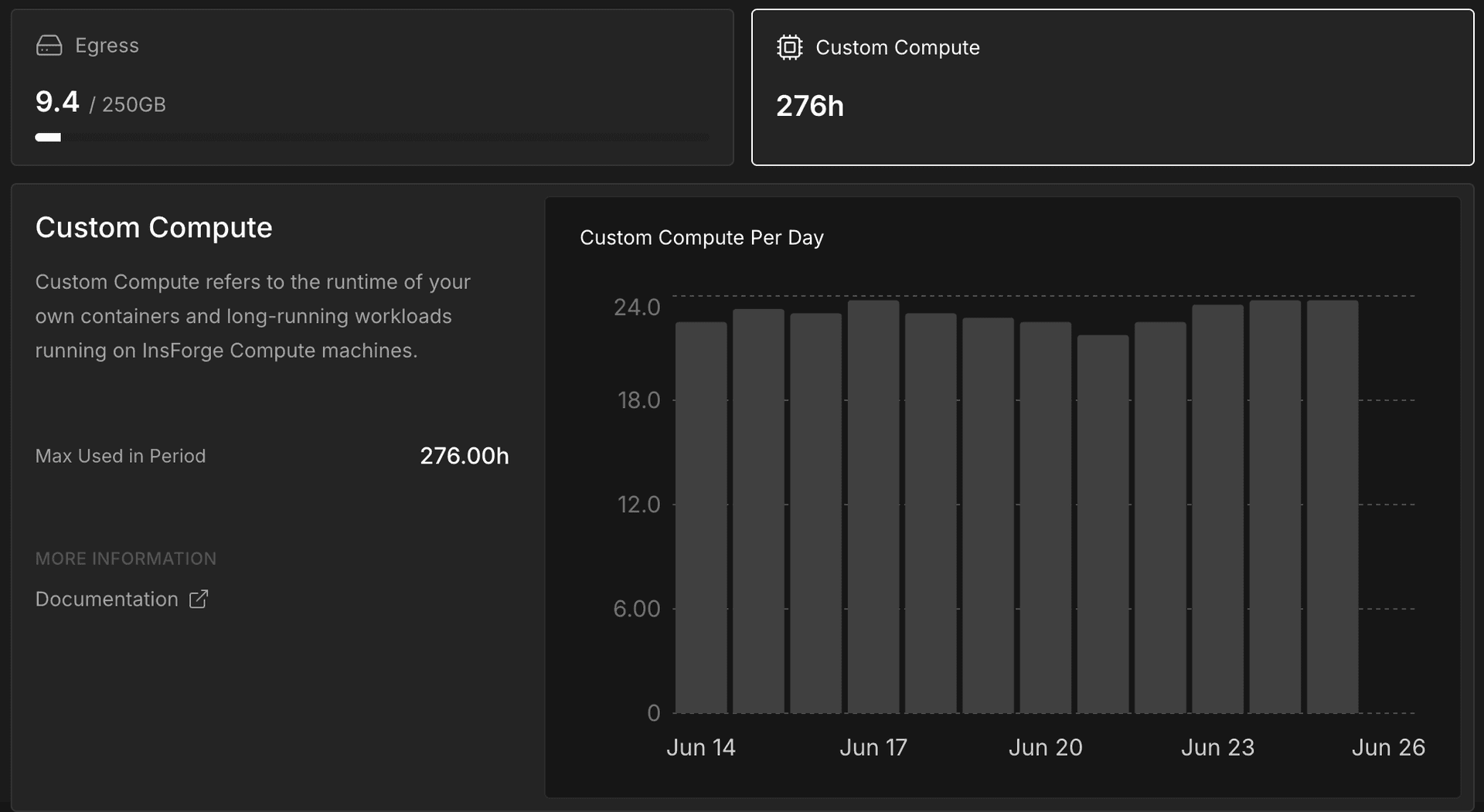
Custom Compute Usage

Custom Compute usage card and daily chart

The cloud dashboard now shows Custom Compute usage on the Usage page.

You can see how much Custom Compute your organization has used in the selected billing cycle, compare it with your plan, and review the trend alongside the rest of your usage.

Composite Key Fixes in the Dashboard

We fixed a set of database dashboard issues around tables that use multi-column keys.

Editing, deleting, and browsing records in these tables is now more reliable. Linked-record views and the schema visualizer also handle these relationships more consistently, especially when a table has several relationships pointing to the same place.

This should make the dashboard feel safer for teams with more advanced database schemas.

More CLI Commands

The InsForge CLI has a broader command surface for day-to-day project operations.

You can now manage more billing tasks from the terminal, including checking subscription status, viewing credits, reviewing billing cycles, opening the billing portal, and starting a plan upgrade.

The CLI also adds support for project transfers, deployment metadata, deployment slug management, and Apify data-source setup.

Project transfers include an extra confirmation step so they do not happen by accident. The Apify flow connects your project once, then lets local tools use the integration without asking you to paste a personal key into your app.

Developer-Created Schemas in the Data API

InsForge now supports developer-created database schemas in the Data API and dashboard workflows.

If your app separates data into multiple schemas, InsForge can now work with those schemas instead of assuming everything lives in the default one. Internal system schemas remain hidden, so custom schemas are available without exposing InsForge-managed internals.

Edge Functions Now Run on Deno Deploy v2

InsForge v2.2.2 moves edge functions from Deno Subhosting onto Deno Deploy v2. Deno is sunsetting Subhosting, and its v1 API shuts down on July 20, 2026.

Projects created on or after June 18, 2026 already run on Deno Deploy v2, with nothing to do. For any project created before then, upgrade it to v2.2.2 from the dashboard and re-deploy each edge function once. The redeploy is what moves a function onto the new runtime. A function you never redeploy stays on Subhosting, and the official notice doesn't promise those keep serving past July 20, so re-deploy before the deadline.

If you call functions through the InsForge SDK, the URL resolves automatically and nothing in your client changes. Only a hardcoded raw function URL needs updating after the redeploy. If a redeploy fails, reach us on Discord.

Razorpay Support in Payments

InsForge Payments now supports Razorpay alongside Stripe. Configure test and live Razorpay keys in Payments → Settings, and InsForge mirrors your Items, Plans, Orders, and Subscriptions into the payments schema, projects payment results into transactions, and verifies every webhook signature for you.

Razorpay works differently from Stripe Checkout: instead of a hosted redirect, your backend creates the Order or Subscription, your frontend opens Razorpay Checkout, and InsForge verifies the returned signature.

typescript
const { data, error } = await insforge.payments.razorpay.createOrder("test", {
  amount: 50000,
  currency: "INR",
  receipt: "order_123",
  subject: { type: "user", id: user.id },
});

The response includes Checkout-native checkoutOptions, ready to pass straight into new Razorpay(options).open(). Subscriptions come with backend routes to cancel, pause, and resume, guarded by RLS policies.

Breaking change: this release reworks the payments foundation to support multiple providers. If your project is currently integrated with InsForge Payments, updating to v2.2.1 may break your existing payment flow. Join our Discord and we will help you migrate.

Razorpay docs

OpenRouter API Key Rotation

You can now rotate the OpenRouter API key behind your Model Gateway. In the dashboard's Model Gateway page, click Rotate next to your key — InsForge issues a fresh key and revokes the old one in a single step, with guards against concurrent rotations.

Use it on a schedule or the moment you suspect a key has leaked.